
Click the above logo to return to the main site
Click the above logo to return to the main site
 by Mick Harper » 1:21 pm
by Boreades » 10:21 pm
Mick Harper wrote: I couldn't. Could you spell it out?
Frisian has the distinction of being the closest of any language to English. ... The unique closeness of this relationship has always provided something of a problem for the theory that English is descended from the languages of German and Danish invaders who came from much further east than Friesland. However, if we accept that both English and Frisian have been spoken in their current locations for the last 10,000 years -- and that the proto-English which gave rise to both of them was also the language of lost Doggerland -- the paradoxes vanish.
The Australian team had access to one of the most comprehensive global rock fingerprint databases and found the best match was from the Orcadian Basin, which includes the Caithness, Orkney, and Moray Firth regions of north-eastern Scotland.
by Boreades » 6:51 pm
The Ridgeway Mystery: You NEVER knew!
by Mick Harper » 6:09 am
by Boreades » 12:22 am
Mick Harper wrote:And why does there always have to be a little homily about how we must all live together in liberal harmony. And why are there always morris dancers somewhere in the background?
by Boreades » 3:14 pm
Taller Than Stonehenge And Forgotten
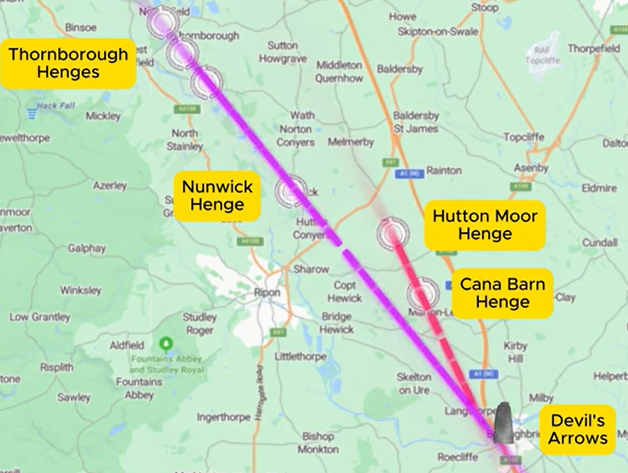
by Boreades » 10:57 pm
Mick Harper wrote:This needs to be reposted on the AEL because of wider implications.
by Boreades » 11:03 pm
by Boreades » 7:51 pm
Submerged Stone Structures in the Far West of Europe ~ During the Mesolithic/Neolithic Transition (Sein Island, Brittany, France)
The most remarkable discovery is the presence of numerous vertical monoliths and
slabs erected on the summits of TAF1 and TAF2A (Figures 7 and 10). On TAF1, the monoliths,
locally protruding 1.7 m in height, are aligned parallel to the axis of the stone structures. The
position of 62 monoliths and large slabs were pinpointed by GPS. In the best-preserved
areas, the monoliths form two parallel lines spaced ca. 1.5 m apart. Some monoliths are
tilted, or, more rarely, laid down by the action of the swell. The large slabs, less than 1 m
high, are arranged vertically between the monoliths
Users browsing this forum: No registered users and 33 guests